





The AI Audit Problem: Why "ChatGPT Said" Isn't a Marketing Strategy
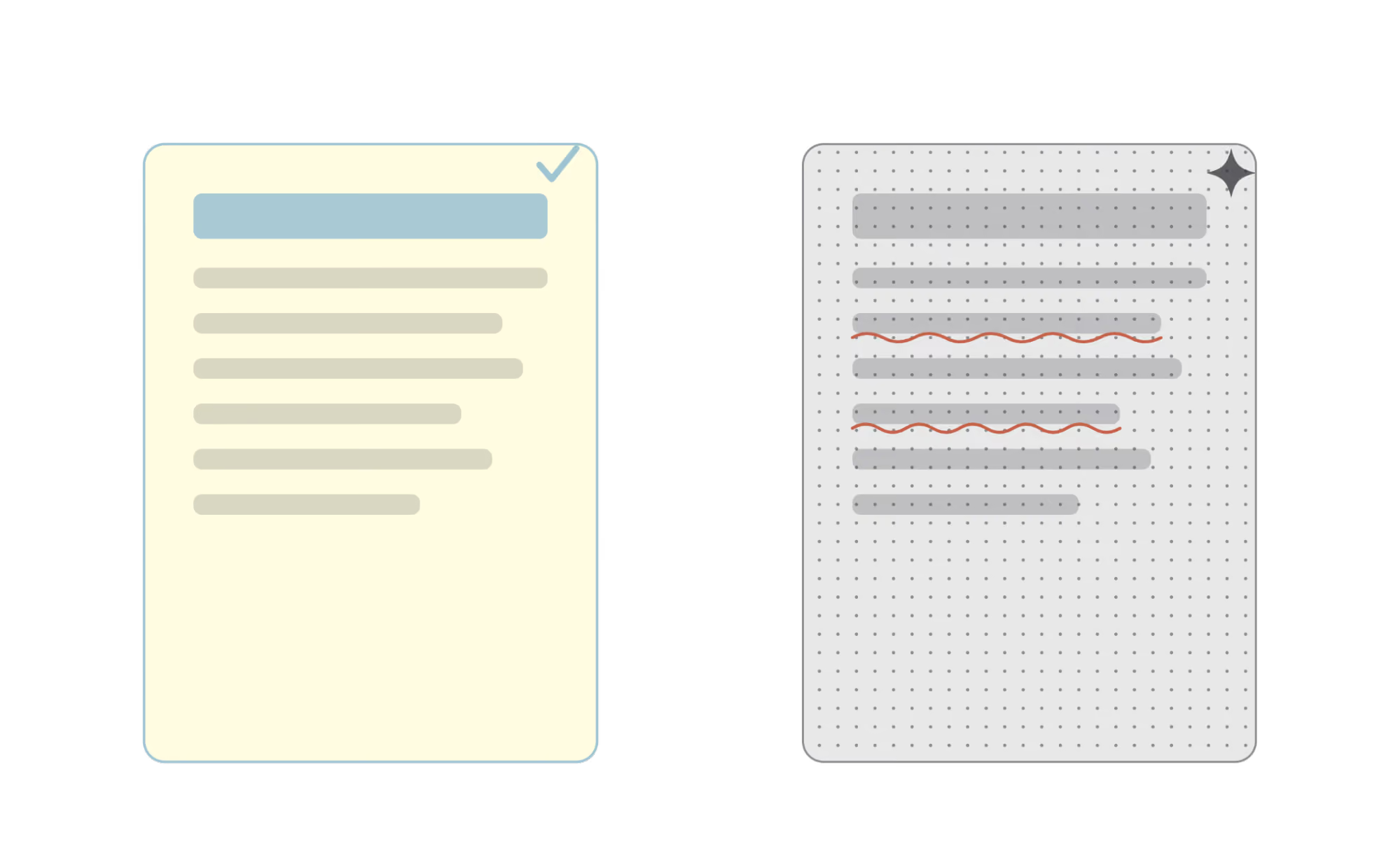

A client recently sent over a marketing audit generated by their AI assistant. Multiple pages, confident tone, specific recommendations. Almost none of it held up.
This is happening more often, and it's worth talking about openly instead of just fielding it quietly every time it lands in our inbox.
What's actually happening
AI tools are good at producing something that looks like an audit. They generate structured feedback, cite plausible-sounding issues, and phrase everything with total confidence. What they don't do is see your account. They don't have access to your Google Ads data, your GA4 property, your Search Console history, your call tracking, or the context behind decisions your agency made three months ago for reasons that made sense at the time.
So when a client asks an AI tool, "What's wrong with my SEO?" or "Audit my marketing," the tool doesn't audit anything. It pattern-matches against generic best practices and generates a response that sounds specific but isn't grounded in your actual account. It might flag a "missing meta description" that was intentionally left as-is for technical reasons, recommend a keyword strategy that ignores the one already in motion, or claim a decline in traffic that doesn't match the actual data.
The result is a document that reads like due diligence but functions more like static. And then someone on our team has to spend real time going through it point by point, explaining what's accurate, what's outdated, and what was never true to begin with.
The real cost isn't the correction. It's the trust gap.
The time it takes to walk through an AI-generated audit isn't the biggest issue. The bigger issue is what it implies: that the agency's explanations aren't enough on their own, and that an outside tool with zero visibility into the account needs to serve as a check on that work.
That's a reasonable instinct in many contexts. Getting a second opinion is smart. But a second opinion needs the same information as the first opinion. An AI tool with no account access isn't a second opinion. It's a guess dressed up as analysis.
If something in a report doesn't add up, or a recommendation doesn't make sense, or you're not sure why a campaign shifted direction, that question should go to the people who can actually see the account. Not because the agency relationship should be immune to scrutiny, but because scrutiny only works when it's pointed at real information.
Marketing is an investment, not a line item to defend
Part of what drives the audit instinct is a framing problem. When marketing spend gets categorized as an expense, it invites the same posture people take with any other expense: minimize it, question it, look for ways to cut corners or automate around it.
Marketing performs differently when it's treated as an investment. Investments get evaluated on return, not just cost. They are given enough time to compound. They get discussed in terms of what they're building, not just what they're consuming. That distinction changes the whole conversation, from "why are we spending this much" to "what is this spend building toward, and are we on pace?"
An agency that's doing its job should be able to answer that question clearly, without hedging and without jargon. If that conversation isn't happening, or isn't landing, that's worth raising directly. It's a much more useful conversation than trying to reverse-engineer strategy through a chatbot.
SEO isn't a system to game
There's a related misconception baked into many AI-generated audits: that SEO is a set of tricks to exploit, and if you're not using the tricks, you're leaving performance on the table. Backlink schemes. Keyword stuffing. Rapid-fire content designed to trip an algorithm rather than answer a question.
That approach hasn't worked reliably in years, and search engines have gotten much better at identifying and penalizing it. What actually works is slower and less exciting to summarize in a bulleted list: clear site structure, content that answers real questions well, technical fundamentals handled correctly, and consistency over time. None of that produces a dramatic audit finding. It also happens to be the thing that holds up.
An AI tool asked to audit SEO will often default to trick-based framing because that's the version of SEO advice most heavily represented in its training data. It's not wrong because it's AI. It's wrong because it's optimizing for a version of SEO that mostly stopped working.
What to do instead
If a question comes up about strategy, performance, or direction, ask the agency. Directly, and as often as needed. A good agency relationship should include real explanations, not just dashboards and jargon. If those explanations aren't coming through, or aren't clear enough to act on, that's a legitimate thing to push back on.
What doesn't help is routing that question through a tool that can't see the account, doesn't know the history, and will answer with confidence regardless of whether it has enough information to be right. That's not an oversight. It's just noise that has to get cleared before the real conversation can start.
Trust the team you hired to do this work, and hold them to a standard of clear communication. Those two things aren't in tension. They're the same expectation, pointed in the right direction.
A quick note to anyone doing this right now
If you've got a marketing agency and you're pasting your own metrics into a chatbot to see if they're lying to you, we need to talk. Not in an audit way. In a "we love you, but this has to stop" way.
Your agency didn't just show up. Somebody there is watching your campaigns more closely than you are, on purpose, because that's the job. Let them tell you what's going on. If the answer doesn't sit right, ask another question. Ask a harder one. Just ask a person who can actually see your account, not a chatbot that's guessing based on vibes and a training cutoff.
We promise the conversation goes faster that way. For everyone.