





Your Business Isn't Showing Up in AI Search Results. Before You Panic, Read This.

It happens regularly now. A client opens ChatGPT or Gemini, types something like "best plumber in [city]," and sees a list of competitors. Their business isn't on it. Then they fire off an email.
It stings. Especially when you know your work holds up against anyone on that list.
Before you overhaul your entire marketing strategy based on one AI-generated response, there are some things worth understanding about how these answers actually work.
AI Search and Google Search Are Not the Same Thing
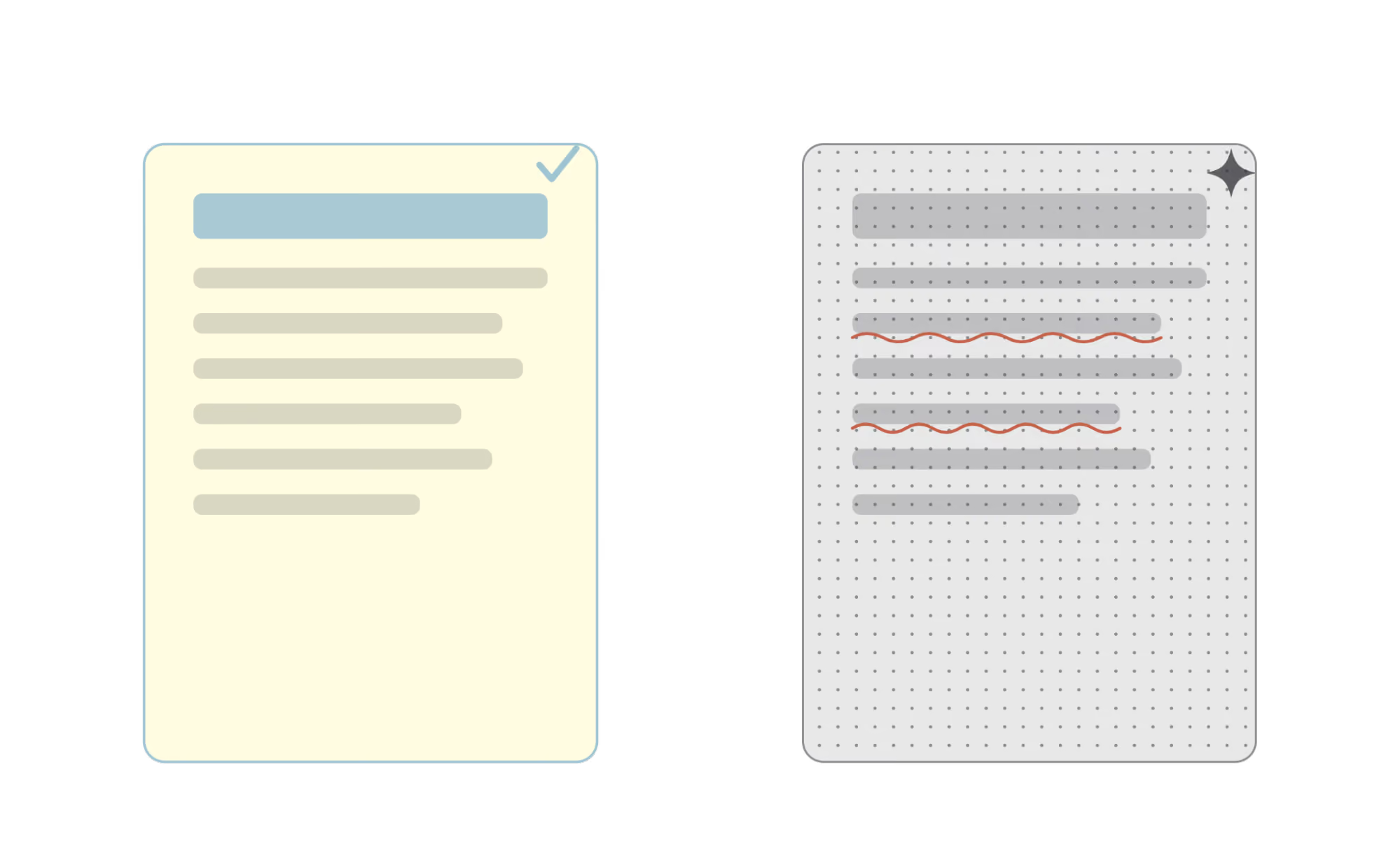
When someone searches Google for "emergency plumber in Phoenix," there's a documented ranking system behind what they see. Google crawls websites, evaluates signals across hundreds of factors, and produces a list. You can audit where you stand, track your progress, and make changes that have somewhat predictable effects.
AI-generated answers work differently.
When someone asks Gemini or ChatGPT for a plumber recommendation, the model draws on a mix of sources: training data it absorbed months or years ago, real-time web browsing in some cases, and a probabilistic judgment about what a useful-sounding answer looks like. It is not ranking your business. It is generating a response that sounds credible to the person who asked.
One is a ranking system. The other is a confident-sounding guess.
Why Your Competitor Showed Up, and You Didn't
There are several reasons this happens, and they don't all point to a problem with your marketing.
Training data recency. Large language models are trained on snapshots of the internet taken at a specific point in time. A competitor with ten years of accumulated content, reviews, and online mentions will have more presence in that training data than a business with two years, regardless of which one does better work. The model doesn't know who fixed more pipes correctly. It knows who has been referenced online more often.
Brand name recognition across the web. AI models are pattern-matchers. When a business name appears frequently across Google reviews, local news coverage, contractor directories, and neighborhood forums, it creates a stronger signal. A business that recently rebranded, or one that operates under a name that differs from what people call it locally, starts with less of that signal even if the underlying reputation is excellent.
Geographic anchoring. When someone asks for recommendations in a metro area, AI tools tend to favor businesses whose digital presence is concentrated there. A plumbing company based in a suburb may serve the entire metro well, but if its website and directory listings are anchored to that suburb, the model may treat it as outside the target geography.
The model may simply be wrong. AI tools fabricate details. They generate business descriptions, reputations, and service specialties that are partially or entirely invented. A competitor receiving a detailed, complimentary write-up from an AI tool does not mean that the write-up is accurate. It also does not mean it will say the same thing the next time someone asks.
One Query Is Not a Benchmark
AI answers are not consistent. Ask the same question twice, and you will often get different results. Ask it on a different platform, and the list changes. Rephrase the question slightly, and different names surface.
There is no stable ranking to track here, the way there is with Google. Treating a single Gemini result as a measure of your marketing performance is like judging your business reputation based on one overheard conversation at a trade show. It tells you something, but it is not a measurement.
What Actually Influences AI Visibility
The factors that affect whether AI models mention your business are largely the same factors that drive organic search performance. This is good news. You are not starting over.
Google Business Profile reviews. AI tools that browse the web in real time rely heavily on Google. Recent reviews where customers describe the work they hired you for and mention where they are located build both your local search ranking and your visibility in AI-generated responses.
Specific, useful content on your website. A blog post called "Why Pipe Corrosion Is More Common in Older Phoenix Homes" does two things: it signals to search engines that you know your market, and it gives AI models something concrete to draw from when answering detailed questions. Generic service pages do neither of those things particularly well.
Consistent name, address, and phone number across directories. Inconsistencies across Yelp, Angi, your website, and your Google Business Profile create conflicting signals. Any system trying to assess whether your business is legitimate and where it operates will treat those inconsistencies as noise.
Third-party mentions and inbound links. Coverage in local publications, links from trade associations, features on home service platforms: these signal that your business exists and that others have found it worth referencing. They contribute to both traditional SEO authority and the broader web presence that AI tools draw on.
What to Do With This Information
If a frustrating AI result prompted you to read this, the answer is the same one it has always been: build a digital presence that accurately reflects how good your business actually is.
Earn reviews consistently. Create content that answers questions your customers are actually asking. Make sure your business information is correct everywhere it appears. Get mentioned by sources with credibility in your space.
Do that over time, and you will show up in organic search, in map packs, and in AI-generated answers. More importantly, you will show up in front of customers who are ready to hire someone and are looking for a reason to trust you.
That is the goal. One AI result on one platform on one day is a very small piece of a much larger picture.